
Lightning Fast Simulations
Adaptive meshing and adaptive frequency sweeps solve only what is needed.
 WaveFEM
Fast, Parametric and Accurate 3D High Frequency Electromagnetic Simulation Software
A finite element solver for microwave and RF design: filters, waveguide components and antennas, all from one desktop application.
Register for beta here!
Adaptive meshing and adaptive frequency sweeps solve only what is needed.

Script geometry in Python, change parameters live and compare design variants.

Import .step, .gds and .dxf files, or CadQuery scripts. Export Touchstone files.
Full 3D vector finite element solutions of the electric field.
Lumped, wave and layout ports.
Built-in library or your own, with lossy dielectrics and metals.
Radiation boundaries and optional PML for antennas.
Fields, S-parameters and 2D or 3D far-field patterns.
All the functionality is a couple of clicks away...

Every simulation follows the same seven steps.
WaveFEM is validated against Ansys HFSS on ten examples: five filters, three antennas and two transmission lines. Each is solved in both tools with the same geometry, the same adaptive refinement target (maximum ΔS of 0.02) and the same frequency sweep. The report compares S-parameter magnitude and phase, far-field realized gain, adaptive mesh convergence and runtime.
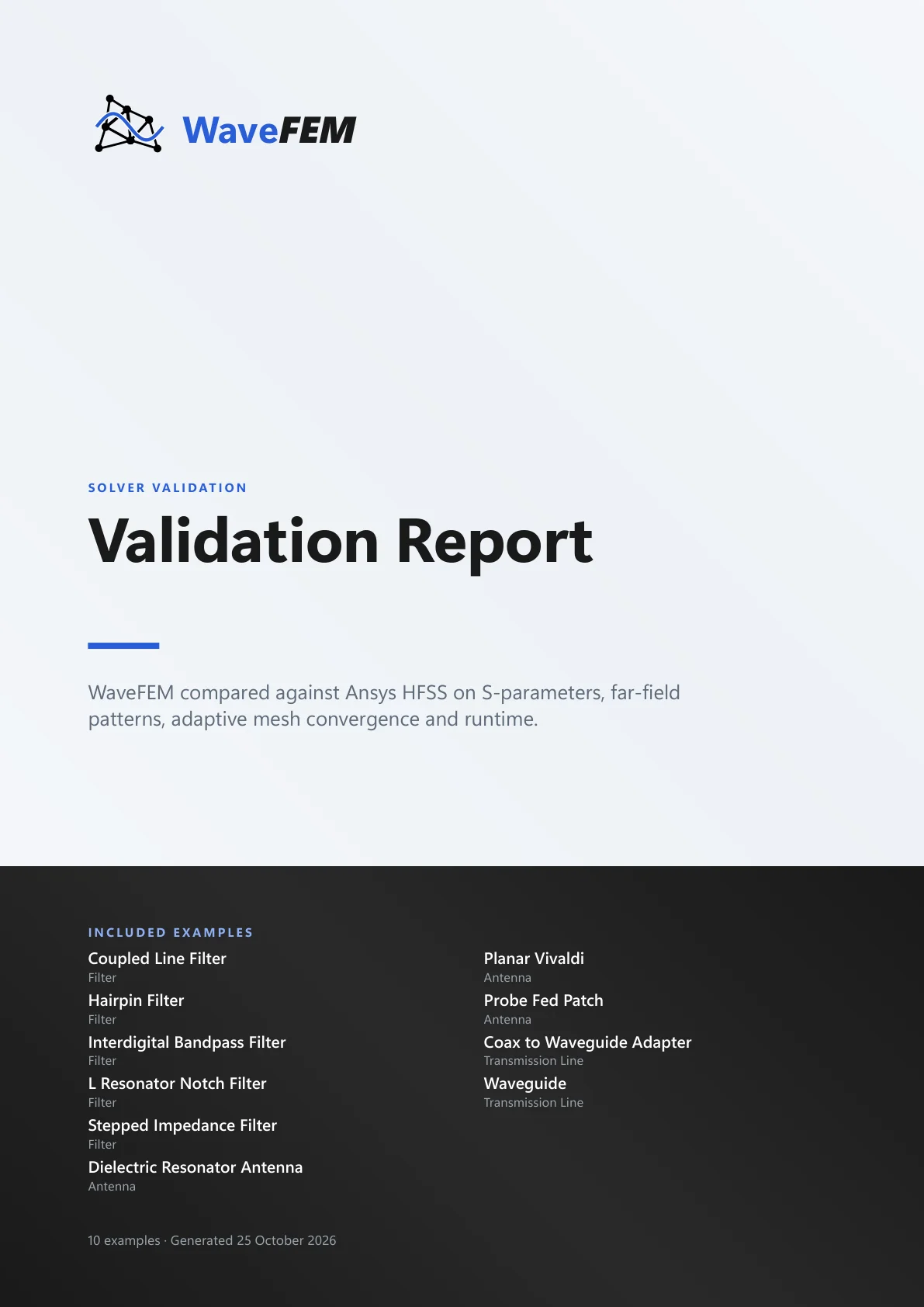 Read the WaveFEM vs. HFSS Validation Report (PDF)
WaveFEM is designed to handle a wide range of electromagnetic simulation challenges across multiple industries and research domains.
Analyze signal integrity, crosstalk, and transmission lines in multi-layer PCBs for high-speed digital applications.
Simulate MMICs, RF chips, and packaging interconnects with accurate parasitic modeling and high-frequency performance analysis.
Design patch antennas, dielectric resonator and Vivaldi antennas, and antenna arrays with radiation pattern prediction.
Simulate bandpass filters, adapters and multiplexers with precise S-parameter calculations for satellite and radar systems.
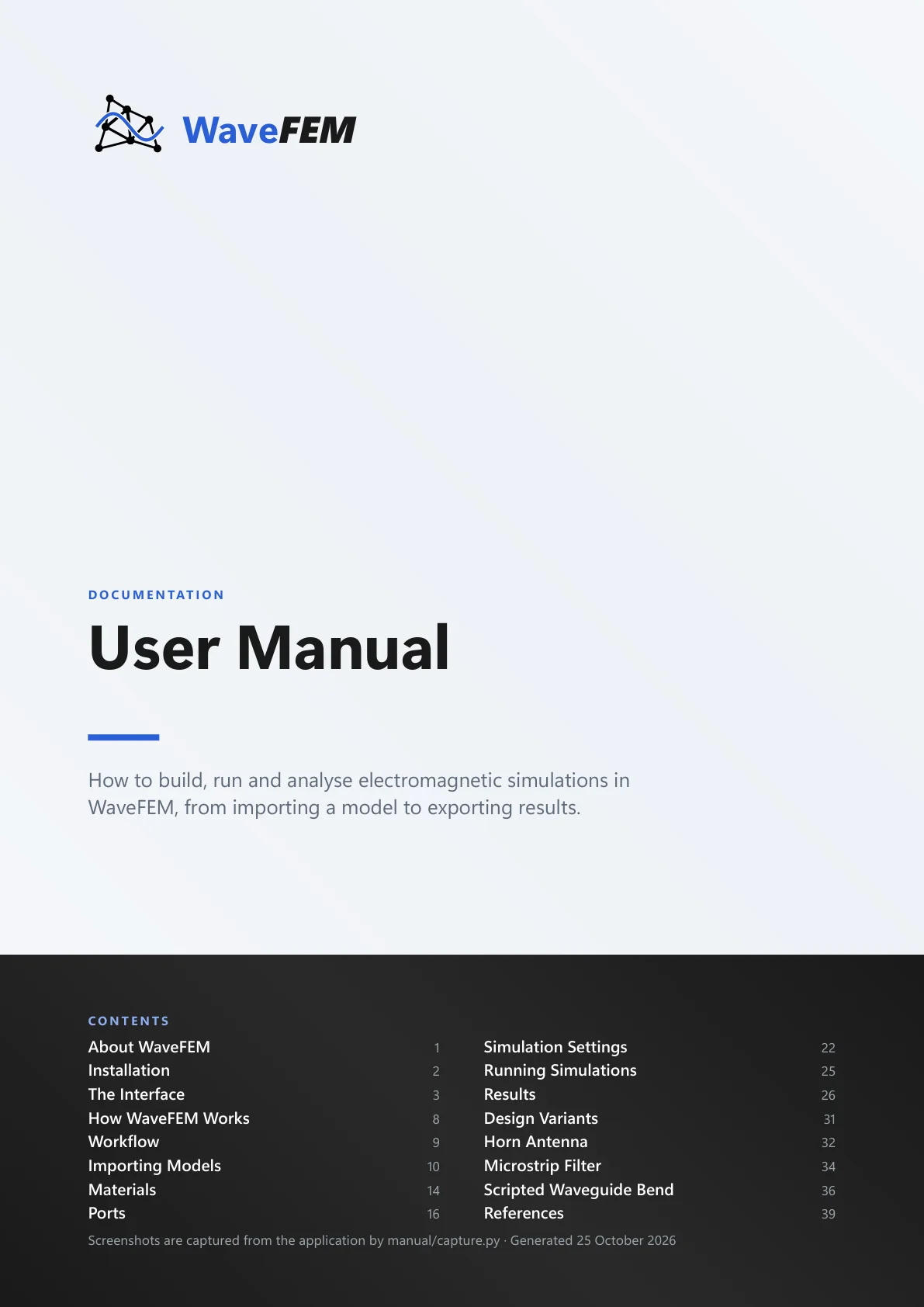 WaveFEM User Manual (PDF)
The user manual takes you from importing a model to exporting results. It covers: